How to do CRO of Landing Page and Why Is It Important?


Getting visitors to a landing page is only the first step. The bigger challenge is convincing those visitors to take action.
A business may invest heavily in SEO, Google Ads, Meta Ads, social media, email marketing or other acquisition channels, yet still struggle to generate enough leads or sales. In many cases, the problem is not the amount of traffic but what happens after visitors arrive.
This is where Conversion Rate Optimisation, commonly known as CRO, becomes important.
Landing page CRO is the process of analysing and improving a landing page so that a higher percentage of visitors complete the desired action. Depending on the business, that action could be submitting a lead form, booking a consultation, requesting a demo, making a purchase, signing up for a service or contacting the company.
Effective Conversion Rate Optimisation is not simply about changing button colours or redesigning a page. It involves understanding user intent, identifying friction, improving messaging, strengthening trust and testing different page elements based on evidence.
For businesses that rely on digital marketing for leads and sales, working with a Landing Page Expert or Funnel Expert can help connect the landing page with the larger customer journey.
What Is Landing Page CRO?
Landing page CRO is a systematic approach to improving the percentage of visitors who complete a specific conversion goal.
The basic calculation is:
Conversion Rate = Conversions ÷ Total Visitors × 100
For example, if 1,000 people visit a landing page and 40 submit a form, the conversion rate is 4%.
The objective of CRO is not necessarily to attract more visitors. Instead, it focuses on making the existing traffic more likely to convert.
This distinction is important. If a business increases advertising traffic without fixing a weak landing page, it may simply spend more money sending visitors to an experience that is not converting efficiently.
CRO combines analytics, user behaviour, copywriting, design, usability, psychology and experimentation. A/B testing is particularly useful because it allows marketers to compare page variations against a defined goal instead of relying entirely on assumptions.
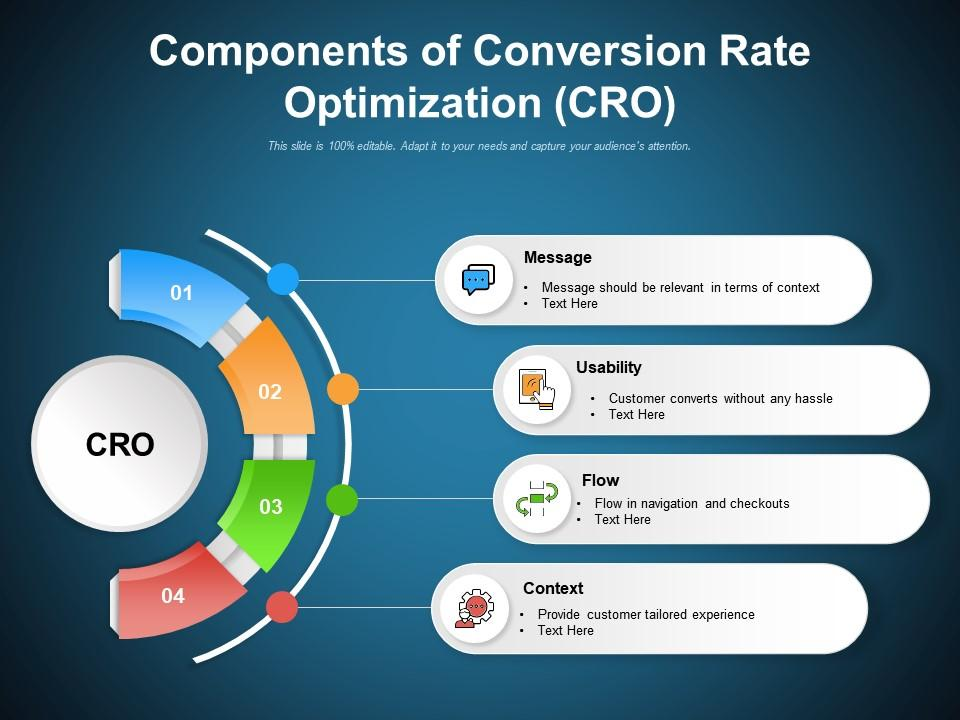
Why Is Conversion Rate Optimisation Important?
The biggest advantage of CRO is that it can help businesses generate more results from traffic they already have.
Consider a landing page receiving 10,000 visitors every month. If it converts at 2%, it generates approximately 200 conversions. If improvements increase the conversion rate to 3%, the same traffic can produce approximately 300 conversions.
The business has gained an additional 100 conversions without necessarily increasing its traffic.
This can make CRO especially valuable for businesses investing in paid advertising. Better landing-page performance can improve the efficiency of the journey between the advertisement and the final conversion.
CRO can also reveal why visitors are not converting. A high bounce rate, low form completion rate, poor CTA engagement or significant mobile drop-off may indicate different problems. Instead of guessing, marketers can use behavioural and conversion data to investigate these issues.
In this sense, CRO is not just a design activity. It is a process for learning how users interact with a business.
How to do CRO of a Landing Page
A successful CRO process should follow a structured approach rather than making random changes. The following steps provide a practical framework.
1. Define the Primary Conversion Goal
Before changing anything, determine what the landing page is supposed to achieve.
A page designed to generate consultation requests should not have the same primary objective as an eCommerce product page. Similarly, a lead-generation page may focus on form submissions while a SaaS landing page could focus on free-trial registrations.
Choose one primary conversion goal and make the page experience support it.
Secondary actions can exist, but they should not compete with the main objective.
2. Understand Your Audience and Search Intent
A landing page should reflect why the visitor arrived.
Someone searching for “SEO services for small businesses” has a different intent from someone searching for “what is SEO.” The first visitor may already be evaluating service providers, while the second may still be researching the subject.
Your landing page messaging should therefore align with the traffic source and visitor intent.
Review search queries, advertising messages, audience segments, customer questions and sales objections. This information can help you understand what visitors expect when they arrive.
A Funnel Expert can be particularly useful here because the landing page should not be considered independently from the rest of the marketing funnel.
3. Improve the Headline and Value Proposition
The headline is one of the first elements visitors see.
A strong headline should quickly communicate what the business offers and why the visitor should care. Avoid vague statements that sound attractive but fail to explain the actual benefit.
For example, instead of:
“Grow Your Business With Our Solutions”
a more specific approach could be:
“Generate More Qualified Leads With a Conversion-Focused Digital Marketing Strategy”
The supporting copy should then explain the offer, its benefits and what makes it relevant to the target audience.
The goal is to reduce the amount of thinking required from the visitor.
4. Optimise Landing Page Speed and Mobile Experience
Page speed is an important part of the user experience. Visitors may abandon a page before interacting with the offer if it takes too long to load.
Google recommends paying attention to Core Web Vitals alongside broader aspects of page experience, including mobile usability, secure browsing and avoiding intrusive experiences.
For CRO, this means optimising images, reducing unnecessary scripts, improving hosting performance and checking how the page behaves on mobile devices.
Mobile optimisation is particularly important because a significant portion of digital advertising and search traffic can arrive through smartphones.
A landing page should load quickly, display important information clearly and allow users to complete the desired action without unnecessary scrolling or zooming.
5. Make the Lead Flow Simple
Every additional step can introduce friction.
If a visitor needs to navigate through multiple pages, complete a long form and provide unnecessary information before understanding what happens next, conversion can become more difficult.
Review the complete journey from landing to conversion.
Ask:
Is the form asking only for necessary information?
Is the CTA easy to find?
Is it obvious what happens after submission?
Are there unnecessary navigation options?
Does the visitor have to repeat information?
Is the next step clear?
For many lead-generation pages, simplifying the path can make the experience easier to understand and complete.
6. Create Clear CTAs and Relevant Offers
A call-to-action should clearly communicate the next step.
“Submit” provides little context. Depending on the offer, alternatives such as “Request a Free Consultation,” “Get a Project Quote” or “Book a Demo” can communicate the action and its value more clearly.
The CTA should also match the offer.
If the landing page promises a consultation but the CTA says “Download Guide,” the visitor may become confused.
The offer itself should answer the visitor's question: “What do I get in return for taking this action?”
7. Strengthen Trust Signals
Visitors may hesitate to convert when they are uncertain about the business.
Trust signals can reduce that uncertainty. Depending on the business, these may include testimonials, customer reviews, client logos, case studies, certifications, relevant awards, transparent policies or credible results.
The placement of trust elements matters as well. A testimonial positioned close to a lead form may address doubts at the moment the visitor is deciding whether to submit it.
However, trust signals should be genuine and relevant. Adding generic claims without evidence is unlikely to create meaningful credibility.
8. Review the Design for Clarity
A visually attractive landing page is not automatically a high-converting landing page.
The design should guide attention towards the most important information. Strong visual hierarchy, readable typography, sufficient spacing and clear sections can make the page easier to understand.
Remove distractions that do not contribute to the conversion goal.
A Landing Page Expert typically looks at the page from the perspective of the visitor: What do they notice first? What do they understand immediately? Where might they hesitate? What could make them leave?
These questions are often more useful than simply asking whether the page looks modern.
Use Data to Identify Conversion Problems
CRO should be supported by data.
Start by reviewing metrics such as landing-page conversion rate, traffic sources, device performance, form completion, CTA clicks and engagement behaviour.
For example, if desktop visitors convert well but mobile visitors leave significantly more often, mobile usability may deserve attention.
If visitors reach the form but rarely submit it, the issue could involve form length, unclear expectations, trust or the perceived value of the offer.
Analytics tells you what is happening. User research, session recordings, heatmaps, surveys and customer feedback can help investigate why.
The combination of quantitative and qualitative information creates stronger CRO hypotheses.
A/B Testing: An Important Part of CRO
Once you identify a potential problem, test a specific hypothesis.
An A/B test compares two versions of a page or element to determine which performs better against a defined conversion objective. Common test areas include headlines, CTAs, forms, offers, images, layouts and trust elements.
For example:
“If we change the headline to communicate the primary customer benefit more clearly, form submissions will increase because visitors will understand the offer faster.”
The important point is to test meaningful hypotheses rather than making several unrelated changes simultaneously.
Testing should also be allowed to collect enough data for a meaningful comparison. Ending an experiment simply because one version appears to be ahead after a short period can lead to unreliable conclusions.
CRO works best as an ongoing cycle:
Analyse → Identify friction → Create hypothesis → Test → Measure → Implement → Repeat
A failed test is not necessarily wasted effort. It can show that a particular assumption was incorrect and help determine where the next optimisation should focus.
How a Funnel Expert Can Improve Landing Page CRO
A landing page is one part of a larger conversion funnel.
Visitors may arrive from an advertisement, organic search result, social media post, email campaign or referral. Their expectations are influenced by the message they saw before clicking.
If an advertisement promises one thing and the landing page communicates something completely different, the visitor may lose confidence.
A Funnel Expert looks at the entire journey rather than treating the landing page as an isolated asset.
This includes the traffic source, advertisement or content, landing-page messaging, offer, form, follow-up process and eventual sales journey.
For example, increasing form submissions is not enough if the resulting leads are poorly qualified. Effective CRO should ultimately support meaningful business outcomes, not simply improve a single surface-level metric.
Common Landing Page CRO Mistakes
One common mistake is changing too many elements without understanding what caused the result. This makes it difficult to learn from the experiment.
Another is focusing excessively on small visual changes while ignoring bigger issues such as unclear messaging, poor offer-market fit or complicated forms.
Businesses also sometimes copy landing-page designs from competitors without considering their own audience and traffic sources.
There is no universal landing page that converts perfectly for every business. What works for one audience may perform differently for another. Testing and customer data should therefore guide optimisation decisions.
Finally, CRO should not be treated as a one-time redesign. A landing page can continue to improve as businesses collect more data and understand their customers better.
Final Thoughts
Landing page CRO is ultimately about reducing friction between visitor intent and business action.
A successful landing page communicates its value quickly, loads efficiently, provides a clear next step, addresses visitor concerns and makes conversion simple. When these elements are supported by analytics and structured experimentation, businesses can make better decisions about their digital marketing performance.
The real value of Conversion Rate Optimisation is not simply achieving a higher percentage on a dashboard. It is generating more meaningful leads, enquiries, registrations or sales from the opportunities already reaching your website.
Whether you manage CRO internally or work with a Landing Page Expert or Funnel Expert, the process should remain focused on understanding users, identifying problems, testing hypotheses and continuously improving the customer journey.
In short, CRO helps make every visit count.
FAQs About CRO
What is CRO in a landing page?
CRO, or Conversion Rate Optimisation, is the process of improving a landing page so that a greater percentage of visitors complete a desired action, such as submitting a form, making a purchase or requesting a consultation.
Why is landing page CRO important?
Landing page CRO can help businesses generate more conversions from their existing traffic. Instead of relying only on increasing visitors, businesses can improve the experience and make more of the visitors they already attract likely to take action.
What should I optimise first on a landing page?
Start with the elements that can have the greatest impact on the conversion journey: the primary offer, headline and value proposition, CTA, lead flow, page speed, mobile experience and trust signals. Data should determine which area deserves priority.
How do I calculate landing page conversion rate?
Divide the number of conversions by the total number of visitors and multiply the result by 100. For example, 50 conversions from 1,000 visitors represent a 5% conversion rate.
Is A/B testing necessary for CRO?
A/B testing is not the only CRO method, but it is a valuable way to compare different versions of a landing-page element using actual visitor behaviour. Tests should have a clear hypothesis, primary metric and sufficient data to produce a meaningful comparison.
Can a Landing Page Expert help improve conversion rates?
A Landing Page Expert can analyse messaging, page structure, user experience, CTAs, forms, trust signals and conversion data to identify potential areas for improvement. The most effective approach combines expertise with testing and real user data.
What is the difference between CRO and a landing page redesign?
A redesign focuses primarily on changing the appearance or structure of a page. CRO is a broader, data-driven process that identifies conversion problems, develops hypotheses, tests changes and measures their impact. A redesign can be part of CRO, but CRO does not necessarily require a complete redesign.
How often should a landing page be optimised?
CRO should be treated as an ongoing process rather than a one-time task. Once one optimisation is implemented, performance data can reveal the next opportunity for improvement. The frequency of testing depends on traffic volume, conversion volume and the complexity of the page.

Comments