Best Funnel Types for Service Businesses

Service businesses rarely grow consistently from one lead source alone. An agency, consultant, real estate professional, lawyer, healthcare provider, coach, financial advisor, IT company or other service provider may receive enquiries from Google, referrals, social media, paid advertising, WhatsApp, email campaigns and previous customers.
The challenge is not simply generating more leads. It is creating a system that moves potential customers from discovery to enquiry, qualification, sales conversation and conversion.

This is where a well-designed marketing funnel becomes important.
The best funnel for a service business is rarely a single channel. Instead, businesses can combine SEO, AEO, referrals, Meta Ads, WhatsApp, email marketing and database reactivation into a connected customer journey.
A practical full-service-business funnel can be understood as:
Discovery → Lead Capture → Qualification → Nurturing → Sales Conversation → Conversion → Retention → Referral
Different channels can enter this journey at different points.
SEO and AEO can create long-term discovery.
Referrals can introduce prospects with an existing level of trust.
Meta Ads can create targeted demand. WhatsApp can turn interest into a direct conversation, while email can nurture people who are not ready to purchase immediately.
The goal is to connect these activities rather than operate them in isolation.
Google's current Search guidance also reinforces the importance of helpful, reliable, people-first content and strong technical foundations. Its guidance for AI search experiences says that existing SEO fundamentals remain relevant to AI Overviews and AI Mode rather than requiring an entirely separate optimization system.
What Is a Funnel for a Service Business?
A marketing funnel describes the stages a potential customer moves through before becoming a paying client.
For a product, the journey can sometimes be relatively short: discover the product, compare it, purchase it.
Service businesses often have a more complicated journey because the customer may need to understand the provider, assess credibility, compare alternatives, discuss requirements and receive a proposal before making a decision.
For example, someone searching for "digital marketing agency for lead generation" may already have commercial intent. They might visit a service page, review case studies and request a consultation.
Another person may search for "how much does digital marketing cost?" without being ready to contact an agency. That person may first read an educational article, download a guide, subscribe to an email list and return later.
Both people can eventually become customers, but they enter the funnel at different stages.
A strong funnel therefore accommodates different levels of intent.
The Full-Service-Business Lead Funnel
Rather than creating completely separate systems for every marketing channel, service businesses can build one connected funnel:
Discovery → Lead Capture → Qualification → Nurturing → Sales Conversation → Conversion → Retention → Referral
Each stage has a different purpose.
At the discovery stage, the objective is to get in front of relevant prospects through SEO, AEO, paid advertising and referrals.
At lead capture, the business gives the prospect a clear next step. This could be an enquiry form, consultation booking, WhatsApp conversation, lead form, downloadable resource or phone call.
Qualification determines whether the lead fits the service, budget, location, timeline and business requirements.
Nurturing is important when the prospect is interested but not ready to buy immediately.
The sales conversation then allows the business to understand the requirement in greater detail, explain the solution and address objections.
After conversion, customer follow-up can create repeat business, reviews and referrals.
This means the funnel does not necessarily end when the invoice is paid.
1. SEO and AEO Funnel
SEO is often treated as a traffic-generation activity, but for service businesses it can become a complete acquisition funnel.
A search-driven funnel might look like:
Informational Search → Educational Content → Service Page → Case Study → Consultation → Lead
For example, imagine a company providing digital marketing services.
A potential customer searches:
"How much does digital marketing cost?"
The user discovers an educational article explaining pricing models, factors that influence costs and what businesses should consider when selecting an agency.
Within that article, relevant internal links can lead to a digital marketing service page, case study or consultation page.
The user may then move from researching the subject to evaluating the provider.
This is much more valuable than simply generating pageviews.
Google explains that SEO helps search engines understand content and helps users find websites through search. It also recommends creating helpful, reliable, people-first content and using descriptive links to help users and search engines understand related pages.

Building the SEO funnel
A service-business SEO funnel can contain several layers.
The first layer is informational content.
Examples include:
How much does digital marketing cost?
How does lead generation work?
What is SEO?
How long does SEO take?
How can a business generate more qualified leads?
The second layer consists of commercial-intent content.
Examples include:
Best digital marketing agency for lead generation
SEO services for small businesses
Meta Ads agency for service businesses
Lead generation agency
Local SEO services
The third layer is the conversion infrastructure.
This includes service pages, location pages, consultation pages, enquiry forms, case studies, testimonials and contact pages.
Internal linking connects these layers.
For example:
Blog → SEO Service Page → Case Study → Consultation Page
Google recommends crawlable internal links and descriptive anchor text because links help users and Google understand relationships between pages and discover content.
Where AEO fits into the funnel
Answer Engine Optimization, or AEO, focuses on making useful information easier for answer-focused search experiences to understand and surface.
Instead of creating content only around broad keywords, businesses can structure content around genuine questions, direct answers, comparisons, definitions, processes and supporting evidence.
For example:
"What does an SEO agency do?"
can be answered clearly near the beginning of an article, followed by deeper information about services, processes, costs, timelines and examples.
The page can then connect the educational answer with relevant commercial resources.
Google's guidance for AI features states that there are no additional technical requirements or special schema requirements specifically needed to appear in AI Overviews or AI Mode. Instead, Google recommends applying established SEO fundamentals, ensuring important content is available in text, maintaining crawlability, using internal links and providing a good page experience.
That makes AEO less about a secret optimization trick and more about creating content that clearly answers questions while providing useful context.
A strong SEO and AEO funnel therefore looks like:
Search Query → Direct Answer → Helpful Supporting Content → Relevant Service → Proof → Enquiry
What is Parasite SEO?
Parasite SEO is commonly used to describe publishing content on third-party websites that already have established authority or visibility.
It can sometimes be part of an off-page content or digital PR strategy, but it should not be confused with the core SEO funnel on a company's own website.
For a service business, third-party publishing may help expose expertise to new audiences, earn legitimate referral traffic and support brand visibility. However, using third-party sites primarily to manipulate rankings can create risks.
Google's site reputation abuse policy addresses situations where third-party content is published on a host site primarily because of the host's established ranking signals. Google also warns against scaled content created mainly to manipulate search rankings rather than help users.
Therefore, if Parasite SEO is included in an overall SEO strategy, the emphasis should remain on genuinely useful, relevant and original publishing rather than mass-produced pages designed solely to exploit another site's authority.

2. Referral Funnel
Referrals are one of the most powerful ways for a service business to introduce trust before the first sales conversation.
The basic journey is:
Existing Client → Recommendation → New Prospect → Conversation → Conversion
A referral prospect may already know something about the business because someone they trust recommended it.
This can reduce the amount of education required at the beginning of the sales process.
However, referrals should not be left entirely to chance.
A structured referral funnel can include client referral programmes, strategic partnerships, professional networks, testimonials, reviews and case studies.
For example, a marketing agency could build referral relationships with web development companies, branding agencies, PR firms, business consultants and technology providers.
The partners may serve similar customers without directly competing for the same service.
Building trust into the referral funnel
The referral process can become even stronger when supported by proof.
A prospect who receives a recommendation can be directed to:
Referral → Website → Case Study → Testimonials → Service Page → Consultation
This allows the business to reinforce the recommendation with independent-looking evidence such as client stories, reviews and examples of previous work.
Reviews and testimonials can also help prospects understand what working with the company is actually like.
Instead of simply saying "we provide excellent service", a business can demonstrate the type of problems it has solved and the outcomes it has helped clients pursue.
3. Paid Media Funnel: Meta Ads

Paid advertising can create a predictable flow of traffic and enquiries when campaigns are properly structured.
For service businesses, Meta Ads can be used for awareness, demand generation, lead capture and remarketing.
A basic Meta Ads funnel can look like:
Ad → Lead Form or Landing Page → Qualification → Follow-Up → Sales Call → Conversion
The first step is defining the audience and offer.
A service business might test different audiences based on industry, interests, location, professional characteristics or previous interactions, depending on what targeting options are available.
The creative then needs to communicate a clear problem and reason to respond.
For example, instead of simply advertising:
"Digital Marketing Services"
an agency could communicate a more specific proposition such as:
"Need a predictable source of qualified leads? See how our lead-generation funnel works."
The next stage could be a Meta Lead Ad or landing page.
A lead form can reduce friction by allowing the prospect to submit basic information without navigating through several pages.
A landing page can provide more context and is useful when the service requires education before the enquiry.
Qualification is critical
Generating leads is not the same as generating qualified opportunities.
A service-business form might ask:
What service are you interested in?
What is your business type?
What is your approximate monthly marketing budget?
What is your primary goal?
When are you looking to start?
The answers can help a sales team prioritize conversations.
Retargeting
Not every prospect converts during the first interaction.
Someone might visit the landing page, read the offer and leave.
Retargeting can bring these visitors back with another message, case study, testimonial or consultation offer.
The funnel becomes:
Ad → Website → Exit → Retargeting → Case Study/Offer → Enquiry
The important principle is testing before scaling.
Businesses can test audiences, creatives, offers, landing pages and lead qualification before committing larger budgets.
Media buying should therefore be viewed as an optimization process rather than simply spending money to generate clicks.
4. WhatsApp Funnel
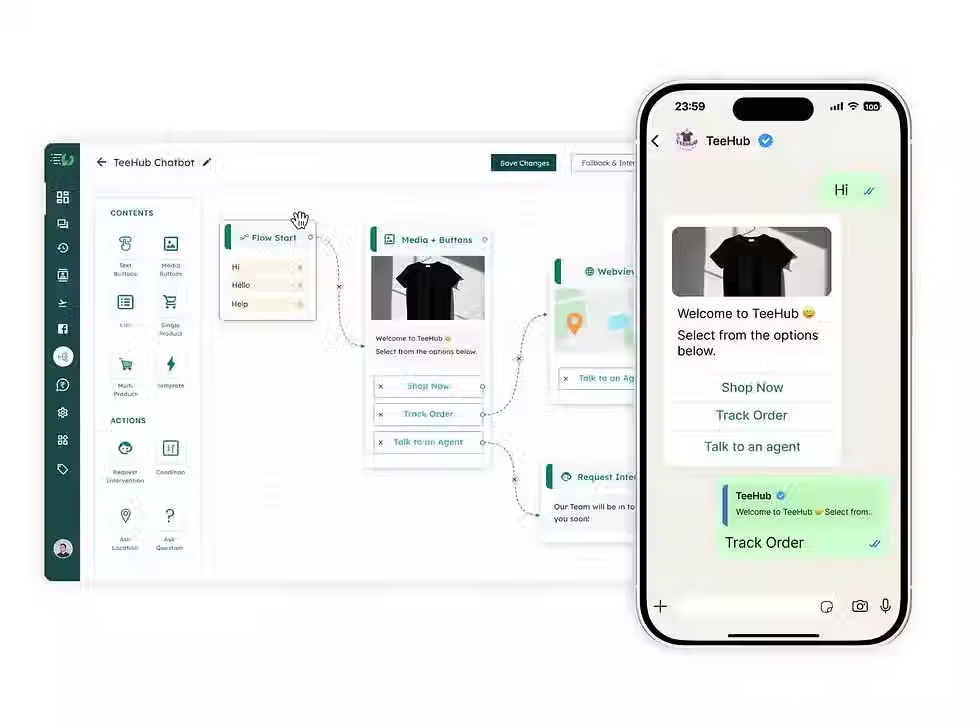
For service businesses where conversations influence purchasing decisions, WhatsApp can become a highly practical conversion channel.
The funnel can look like:
Ad/Search/Referral → WhatsApp → Initial Response → Qualification → Information Sharing → Sales Call → Conversion
Instead of forcing every prospect through a long website journey, the business can provide a direct conversational path.
For example, a potential client may click an advertisement and start a WhatsApp conversation.
The first response can acknowledge the enquiry and ask a few relevant qualification questions.
The business can then share:
Portfolio examples
Service information
Pricing ranges
Case studies
Brochures
Meeting links
Frequently asked questions
The conversation can eventually move toward a consultation or sales call.
Automation without losing the human element
Automated first responses can improve response times, but service businesses should avoid turning the entire customer experience into a robotic sequence.
The best approach is often a combination:
Automated acknowledgement → Qualification → Human conversation → Consultation
Businesses should also distinguish between inbound conversations and outbound messaging.
WhatsApp's Business Messaging Policy states that businesses need appropriate user opt-in for contacting people and must respect requests to stop receiving communications.
That distinction becomes particularly important when businesses use databases for
reactivation campaigns.
5. Email Marketing Funnel
Email remains useful for prospects who have shown interest but are not ready to buy immediately.
The funnel can look like:
Lead Capture → Welcome Email → Educational Content → Proof → Offer → Consultation → Follow-Up
Suppose someone downloads a guide called:
"10 Ways to Generate More Qualified Leads for Your Business."
That person may not need an agency today.
Instead of treating the download as the end of the process, the business can introduce a relevant email sequence.
The first email can deliver the resource.
The next can explain a common lead-generation problem.
Another can provide a case study.
A later message can explain the company's approach.
Finally, the business can invite the subscriber to request an audit, consultation or strategy call.
This creates a longer relationship between the initial enquiry and purchase.
Why nurturing matters
Service purchases often involve consideration.
A prospect may have to discuss the decision with a partner, director or finance team.
They may also be comparing several providers.
Email allows a company to remain visible during this decision period without requiring the prospect to return to the website manually.
It can also support reactivation when a lead becomes relevant again.
6. Bulk WhatsApp and Email Reactivation Funnel
Many service businesses already possess an underused marketing asset: their existing database.
This can include:
Past enquiries → Old leads → Existing customers → Previous clients → Newsletter subscribers
Instead of continually searching for new prospects, a business can develop a reactivation funnel.
The process might look like:
Existing Database → Segmented Campaign → Response → Qualification → Sales Conversation → Conversion
The campaign could promote:
A new service
A seasonal offer
A new location
A limited consultation programme
A new case study
An updated service package
A relevant industry solution
Segmentation matters.
A past client may need a different message from someone who submitted an enquiry two years ago but never purchased.
For example:
Past customer → New service announcement
Old enquiry → Updated solution or consultation
Existing client → Cross-sell or upgrade
Inactive prospect → Educational reactivation campaign
Permission-based communication matters
Reactivation should not become indiscriminate bulk messaging.
Businesses should use permission-based databases, appropriate consent, clear identification and relevant communication. WhatsApp specifically requires opt-in for ongoing business messaging and requires businesses to honor opt-out requests.
The objective is to reactivate genuine business relationships, not overwhelm people with unsolicited promotions.
How the Funnel Types Work Together
The real strength comes from connecting the channels.
Consider a service business offering digital marketing.
A potential customer searches:
"How much does digital marketing cost?"
They discover a blog article through SEO.
The article answers the question and links to a relevant service page.
The visitor explores the service page but does not enquire.
Later, they see a relevant Meta Ad.
They click through to a landing page and start a WhatsApp conversation.
The business qualifies the enquiry and schedules a consultation.
After the consultation, the company sends a proposal.
The prospect does not immediately decide.
An email follow-up provides a relevant case study.
The prospect eventually becomes a client.
After successful delivery, the business asks for a review and referral.
One customer journey has now involved:
SEO → Content → Paid Media → WhatsApp → Sales → Email → Referral
This is why a service business should think in terms of an ecosystem rather than isolated marketing campaigns.
A Practical Funnel Framework for Service Businesses
The following structure can be used as a starting point:
Funnel Stage | Primary Channels |
Discovery | SEO, AEO, Meta Ads, Referrals |
Lead Generation | Service Pages, Landing Pages, Meta Lead Ads, WhatsApp |
Qualification | Forms, WhatsApp, Calls, CRM |
Nurturing | Email, WhatsApp, Remarketing, Content |
Conversion | Sales Calls, Consultations, Proposals |
Retention | Email, WhatsApp, Customer Follow-Up |
Referral | Reviews, Referral Programmes, Client Advocacy |
The important point is that every stage should have a defined objective.
For example, the purpose of a blog article is not necessarily to generate an immediate sale.
Its role may be to answer a question, establish expertise and move the visitor toward a relevant commercial page.
Similarly, the purpose of a Meta Ad may be to generate an enquiry, while the purpose of WhatsApp is to qualify that enquiry.
How to Choose the Right Funnel for Your Service Business
There is no universal funnel that works identically for every service business.
The appropriate combination depends on purchase complexity, customer lifetime value, sales cycle, geography, competition and the level of trust required before purchase.
A local service provider may benefit heavily from local SEO, reviews, referrals and WhatsApp.
A B2B consulting company may require SEO, LinkedIn or other professional outreach, downloadable resources, email nurturing and sales calls.
A marketing agency may combine SEO, AEO, Meta Ads, content marketing, referrals and consultation funnels.
A high-ticket professional service may require several weeks or months of nurturing before conversion.
The question should therefore not be:
"Which funnel is the best?"
A better question is:
"Which combination of channels matches how my customers discover, evaluate and purchase my service?"
SEO, Digital Marketing and Funnel Strategy
SEO should be treated as one part of a broader Digital Marketing system.
A strong SEO strategy can attract prospects who are already searching for solutions.
Content can educate them.
Service pages can convert commercial intent.
Case studies can provide proof.
Lead forms and consultation pages can capture demand.
Email and WhatsApp can nurture or qualify the lead.
This creates a connection between visibility and revenue.
SEO therefore becomes much more useful when its performance is measured beyond rankings.
Businesses should look at metrics such as:
Organic enquiries
Qualified leads
Consultation bookings
Conversion rate
Cost per qualified opportunity
Revenue influenced by organic search
Assisted conversions
This helps separate traffic from actual business value.
Why SEO and AEO Should Be Connected to Conversion Pages
A common mistake is creating informational content without a clear next step.
For example, a 2,500-word article may attract thousands of visitors but provide no meaningful path toward a service.
A better structure is:
Question → Answer → Explanation → Example → Related Service → Proof → CTA
For a digital marketing business, an article about lead generation could naturally connect to:
Lead Generation Service
Meta Ads Service
SEO Service
Funnel Strategy
Case Studies
Consultation
Google's guidance for AI search emphasizes that useful content should remain accessible, crawlable and available in textual form, while internal links help users and search engines discover related pages.
This means the SEO/AEO funnel should be designed as a connected information architecture rather than a collection of unrelated blog posts.
Where Media Buying Fits
Media buying becomes particularly valuable when the business needs faster demand generation while organic channels develop.
SEO can take time to establish visibility.
Paid campaigns can put a service offer in front of a selected audience much sooner.
But paid traffic needs somewhere productive to go.
That is why Media Buying should not be separated from landing pages, lead qualification, CRM systems and sales follow-up.
A campaign that generates cheap leads but poor-quality opportunities may not create meaningful business value.
The complete path matters:
Media Buying → Landing Page/Lead Form → Qualification → Sales Follow-Up → Revenue
This is where funnel expertise becomes important.
What a Funnel Expert Actually Does
A Funnel Expert should not focus only on creating landing pages.
The larger responsibility is understanding the complete customer journey.
That can include:
Traffic source
Audience
Offer
Landing page
Lead form
Qualification
CRM
Follow-up
Nurturing
Sales process
Conversion tracking
Retention
Referral
If leads are arriving but sales are low, the problem may not be the advertising campaign.
It could be the offer, landing page, qualification process, response time, sales conversation or follow-up sequence.
A complete funnel analysis looks at the entire journey.
Common Funnel Mistakes Service Businesses Make
One common mistake is relying on a single lead source.
If all enquiries come from one advertising platform or one referral partner, the business becomes vulnerable to changes in performance.
Another problem is sending every prospect directly to a generic homepage.
A user searching for a specific service should ideally land on a page that directly addresses that need.
Poor qualification is another issue.
A business can generate hundreds of enquiries but waste sales resources if the leads do not match the target customer.
Slow follow-up can also damage conversion rates.
Finally, many businesses stop communicating after a lead says "not right now."
A prospect who is not ready today may become a customer later.
This is where email, WhatsApp, content and remarketing can support long-term nurturing.
How to Measure a Service Business Funnel
The funnel should be measured from the first interaction through revenue.
Useful metrics include:
Traffic by channel
Lead conversion rate
Cost per lead
Qualified lead rate
Cost per qualified lead
Consultation booking rate
Proposal rate
Sales conversion rate
Customer acquisition cost
Customer lifetime value
Referral rate
Repeat business
The most important metric depends on the business model.
For a high-value consulting company, 20 highly qualified enquiries may be more valuable than 500 low-intent leads.
For that reason, optimizing only for clicks, impressions or raw lead volume can produce misleading results.
A Balanced Funnel Strategy for your business
Modern service businesses can build a more resilient acquisition system by combining several layers.
SEO and AEO create discoverability.
Content answers questions and builds authority.
Referrals create trust.
Meta Ads generate targeted demand.
WhatsApp creates direct conversations.
Email keeps prospects engaged.
Reactivation campaigns bring previous opportunities back into the funnel.
Sales teams convert qualified demand.
Reviews and referrals feed new prospects into the top of the funnel again.
This creates a circular growth system:
Discovery → Lead → Qualification → Nurturing → Sale → Customer → Review → Referral → New Discovery
The objective is not to force every customer through the same journey.
Instead, the business should create multiple entry points that eventually connect to the same conversion infrastructure.
Final Thoughts
The best funnel types for service businesses are not necessarily individual funnels competing against one another.
SEO and AEO can attract people actively searching for answers and services.
Referral funnels can introduce prospects through existing relationships.
Meta Ads can generate targeted demand and support retargeting.
WhatsApp can turn interest into conversations.
Email marketing can nurture leads over longer decision cycles.
Database reactivation can unlock opportunities that already exist within the business.
Together, they create a complete lead-generation ecosystem.
For businesses investing in SEO, Digital Marketing and Media Buying, the biggest opportunity is to connect acquisition with conversion. Traffic should have a destination, leads should have a qualification process, prospects should have a nurturing journey and customers should have opportunities to return or refer others.
The result is a marketing system that is less dependent on one channel and more focused on the complete customer journey.
When these elements are planned together, funnel strategy becomes more than a collection of campaigns. It becomes the infrastructure that connects visibility, conversations, sales and long-term business growth.
Frequently Asked Questions About Funnel Types
What is the best funnel type for a service business?
There is no single funnel that is universally suitable for every service business. The right combination depends on factors such as customer intent, service value, sales cycle, location and how much trust customers need before purchasing.
Many service businesses can benefit from combining SEO, referrals, paid advertising, WhatsApp and email nurturing rather than relying on one channel.
What is a service business sales funnel?
A service business sales funnel is the journey a potential customer takes from discovering a company to becoming a client. It can include discovery, lead capture, qualification, nurturing, consultation, proposal, conversion and post-sale follow-up.
How does an SEO funnel work for service businesses?
An SEO funnel begins when someone searches for information or a solution. The visitor discovers useful content, moves toward a relevant service page, reviews proof such as case studies or testimonials and eventually submits an enquiry or books a consultation.
A typical journey is:
Search → Blog → Service Page → Case Study → Consultation
What is an AEO funnel?
An AEO funnel structures content around questions and answers so that users and search systems can understand the information clearly. It can begin with a question-based search, provide a direct answer and then guide the visitor toward supporting information and relevant services.
Google currently states that the same foundational SEO practices remain important for AI search experiences such as AI Overviews and AI Mode.
Can SEO generate leads instead of just website traffic?
Yes. SEO can be structured around commercial intent and conversion paths rather than only informational traffic.
Service pages, location pages, comparison content, case studies, consultation pages and enquiry forms can help turn search visibility into leads.
What is a referral funnel?
A referral funnel begins when an existing customer, business partner or professional contact recommends a service to a new prospect.
The prospect can then visit the website, review testimonials or case studies and move toward a consultation.
How does a Meta Ads funnel work?
A typical Meta Ads funnel can use an advertisement to generate interest, followed by a Meta Lead Ad or landing page. The lead is then qualified and followed up through WhatsApp, email or a sales call.
Retargeting can be used to reconnect with people who interacted with the campaign but did not initially convert.
Is WhatsApp useful for service-business funnels?
WhatsApp can be particularly useful when customers need to ask questions before purchasing. It allows businesses to handle enquiries, qualify prospects, share information and move suitable leads toward a sales call or consultation.
Businesses using WhatsApp for outbound communication should follow applicable consent requirements and WhatsApp's business messaging policies.
Why is email marketing important in a service funnel?
Email marketing helps maintain communication with prospects who are interested but not ready to purchase immediately.
Educational content, case studies, useful resources and consultation invitations can keep the business relevant throughout a longer buying journey.
What is a reactivation funnel?
A reactivation funnel targets existing databases such as previous enquiries, old leads and existing customers.
A segmented campaign can introduce a new service, seasonal offer, relevant update or consultation opportunity and encourage the recipient to restart a conversation.
What is Parasite SEO and should service businesses use it?
Parasite SEO is an informal term generally used for publishing content on established third-party websites to benefit from their existing visibility or authority.
Third-party publishing can be useful when it provides genuine value, reaches a relevant audience or supports legitimate digital PR. However, using third-party sites primarily to manipulate search rankings can create risks under Google's site reputation abuse and spam policies.
What does a Funnel Expert do?
A Funnel Expert looks at the entire journey from traffic acquisition to conversion. This can include advertising, SEO, landing pages, lead forms, qualification, CRM workflows, nurturing, sales processes and conversion tracking.
The objective is to identify where prospects are being lost and improve the complete customer journey rather than optimizing only one marketing channel.
How many funnels should a service business have?
A service business does not necessarily need several completely separate funnels. It can be more effective to create one overall customer journey with multiple acquisition channels feeding into shared lead capture, qualification, nurturing and sales processes.
For example:
SEO + Referrals + Meta Ads → Lead Capture → Qualification → WhatsApp/Email → Sales Call → Conversion
What is the difference between a lead funnel and a sales funnel?
A lead funnel primarily focuses on attracting and capturing potential customers. A sales funnel usually extends further into qualification, consultation, proposal, negotiation and conversion.
For service businesses, the two are often connected and should be measured as one customer journey.


Comments