Best Ways to Generate Leads: Build the Right Funnel for Your Business

Generating leads is not about being present on every marketing channel. It is about building a customer journey that attracts the right people, captures their interest, builds trust and makes it easy for them to take the next step.
A local business may want phone calls or WhatsApp enquiries. A B2B company may need consultation requests or product demos. An eCommerce brand may focus on purchases, while a real estate company may want site visits and project enquiries.
The best lead generation strategy therefore starts with the business model, audience and sales process.
Modern Digital Marketing combines paid advertising, SEO, social media, content, referrals, landing pages and direct communication. When these channels work together inside a structured funnel, businesses can create a more consistent path from discovery to conversion instead of relying on random enquiries.

What Is a Lead Generation Funnel?
A lead generation funnel is the journey a potential customer takes from discovering your business to becoming a lead and, eventually, a customer.
At the top of the funnel, your focus is visibility. People may discover your brand through Google Search, Instagram, Facebook, YouTube, referrals or organic content.
In the middle, they evaluate whether your business can solve their problem. They may read a service page, compare providers, view testimonials, watch videos or visit your social profiles.
At the bottom, they take an action such as submitting a form, calling your business, booking an appointment or making a purchase.
Google's current lead-generation guidance recommends mapping the complete lead-to-sale journey and identifying which conversion actions are closest to meaningful business outcomes rather than optimizing only for the largest possible number of leads.
A simple funnel can therefore look like:
Traffic → Engagement → Lead Capture → Qualification → Nurturing → Sale
The exact structure changes from one business to another.
1. Use Meta Ads for Fast Lead Generation
Meta Ads can help businesses generate demand and reach potential customers across Facebook and Instagram. For companies that want a steady flow of enquiries, Meta can become an important part of the top and middle sections of the funnel.
One approach is to use Meta's lead form experience, where prospective customers can submit their details within the advertising environment. This can reduce friction for mobile users and works well when the objective is to capture an initial enquiry.
Another option is to send users to a dedicated landing page. This gives the business more room to explain its offer, display testimonials, answer common objections and provide more information before requesting contact details.
For example, a real estate company could promote a property through Meta Ads and send interested users to a page containing project information, amenities, floor plans and a site-visit form.
The right choice depends on lead quality, sales cycle and customer intent. A campaign producing inexpensive enquiries is not necessarily successful if most of those enquiries never become opportunities.
That is why Meta Ads should be measured against qualified leads and eventual sales rather than lead volume alone.
2. Capture High-Intent Customers with Google Ads
While Meta Ads can help create demand, Google Search is particularly useful for capturing people who are already looking for a solution.
A prospect searching for “SEO agency for small business” or “digital marketing company in Delhi” has actively expressed a need. The search does not guarantee a sale, but it provides a strong intent signal that can be valuable for lead generation.
Google recommends matching the ad message and keywords with a relevant landing page. It also notes that landing page usefulness, relevance and ease of navigation can affect the user's experience after an ad click.
A strong search funnel might look like:
Search Query → Relevant Ad → Service Landing Page → Enquiry → Sales Follow-Up
Avoid sending every search visitor to a generic homepage. Someone searching for SEO services should ideally arrive on a page dedicated to SEO, with clear information about the service, process, proof and next steps.
Google also provides lead form options directly within eligible campaigns, helping businesses capture information without always requiring a separate website visit.
3. Build Sustainable Lead Generation Through SEO
Paid advertising can produce results quickly, but SEO can create a long-term source of qualified organic traffic.
The foundation is not simply publishing large numbers of blogs. A strong SEO strategy builds useful pages around the topics, services, locations and questions that matter to the audience.
An SEO-driven funnel may include service pages, location pages, comparison articles, educational guides, case studies and FAQ sections.
For example, an agency could publish:
“Best Digital Marketing Strategies for SMEs”
then connect it to:
“Digital Marketing Services for Small Businesses”
and ultimately guide interested readers toward:
“Book a Marketing Consultation.”
This creates a logical journey from information to commercial intent.
Google's current Search guidance emphasizes helpful, reliable and people-first content and warns against producing content mainly to manipulate rankings. It also notes that Google can understand related searches without requiring every keyword variation to be repeated exactly throughout a page.
That means SEO Experts should focus on depth, relevance and usefulness rather than keyword repetition.
4. Create Landing Pages That Convert

Generating traffic is only half the job. Your landing page has to turn attention into action.
A good landing page should immediately communicate what you offer, who it is designed for and why the visitor should trust you. The call to action should also be clear.
Depending on the business, useful conversion elements may include customer testimonials, case studies, pricing guidance, FAQs, project examples, trust signals and a concise enquiry form.
The landing page should continue the promise made by the advertisement or search result. Google specifically recommends strong alignment between keywords, ad copy and the destination page because visitors are more likely to leave when they cannot quickly find the information they expected.
For high-ticket products or services, the page can also qualify leads by asking relevant questions such as budget range, business requirements, project type or expected timeline.
The objective is not simply to maximize form submissions. It is to attract and capture prospects who are genuinely relevant to the business.
5. Use Retargeting to Bring Interested Visitors Back
Not everyone converts on their first website visit.
A prospect may discover your business through a blog, visit a service page, compare competitors and return several days later. Retargeting can help businesses reconnect with people who have previously interacted with their website or advertising ecosystem, subject to applicable privacy, consent and platform requirements.
The message should reflect the person's stage in the journey.
Someone who viewed a pricing page may respond to a consultation message. Someone who read an educational article may need a case study or detailed service explanation.
Retargeting works best when it continues the conversation rather than repeating the exact same advertisement indefinitely.
6. Use WhatsApp for Lead Nurturing
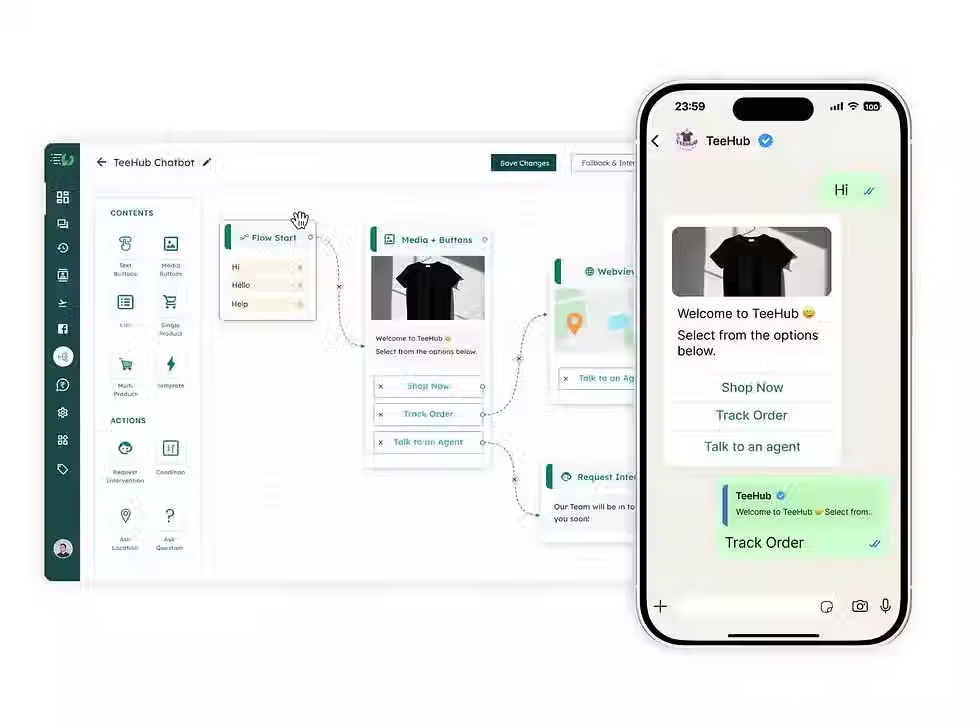
Capturing a lead does not mean the prospect is ready to buy immediately.
For many businesses, WhatsApp can provide a convenient channel for continuing conversations with prospects who have appropriate permission to receive business communication.
A business can use WhatsApp to answer questions, share brochures, confirm appointments, provide product information or continue a conversation that began through a website or advertisement.
For example, an education company may send course information after an enquiry. A real estate business may share project details with an interested prospect. A service company may confirm a consultation and provide the information needed before the meeting.
The important principle is relevance and permission. Lead nurturing should help prospects make decisions rather than turn into repetitive promotional messaging.
7. Turn Happy Customers into a Referral Funnel
Referral marketing is one of the simplest ways to strengthen a lead generation system.
When customers have a positive experience, they can become a source of new business through recommendations, introductions and reviews.
The process starts with delivering a strong customer experience. Afterward, businesses can request genuine reviews, collect testimonials and make it easy for satisfied customers to recommend their services.
Those reviews can then become part of future marketing assets such as landing pages, social posts and paid campaigns.
This creates a loop in which customer satisfaction supports trust, trust improves conversion and successful customers become another source of potential leads.
8. Measure Lead Quality Instead of Only Lead Volume
A high number of leads can look impressive in a report, but volume alone does not tell you whether the funnel is profitable.
Imagine one campaign produces 150 leads and another produces 60. The first appears stronger until the sales team discovers that only a small percentage of those leads are relevant, while the smaller campaign generates significantly more actual customers.
This is why businesses should track metrics further down the funnel, including cost per qualified lead, lead-to-opportunity rate, sales conversion rate, customer acquisition cost and revenue generated by channel.
Google's current advertising tools increasingly support qualified-lead and converted-lead measurement, helping businesses connect advertising activity with later stages of the sales journey.
For Funnel Experts, this is a critical distinction. The job is not simply to generate more enquiries. It is to identify where quality improves and where prospects are being lost.
9. Combine Multiple Lead Sources
The strongest lead generation systems rarely depend on one channel alone.
A business may use Google Ads to capture high-intent searches, Meta Ads to generate demand and retarget engaged prospects, SEO to build long-term visibility, referrals to strengthen trust and WhatsApp to nurture active enquiries.
Each channel has a different role.
Paid media can provide speed. SEO can create sustainable organic discovery. Content can answer important questions before the sales conversation. Referrals can transfer trust. Direct communication can help move interested prospects toward a decision.
This combination also reduces dependence on a single traffic source.
A business that relies entirely on paid advertising may become vulnerable to rising acquisition costs. A company that depends exclusively on SEO may have a slower path to immediate growth. A balanced funnel provides multiple opportunities to attract and convert customers.
10. Build the Funnel Around Your Business Model
There is no universal lead funnel that works equally well for every business.
A local salon may need local SEO, Google Search, Meta Ads and direct messaging.
A B2B company may need educational SEO content, search campaigns, case studies, webinars, consultations and longer lead nurturing.
A real estate business may combine Meta Ads, Google Search, project landing pages, remarketing, WhatsApp communication and site visits.
An eCommerce brand may focus on paid social, search, product pages, remarketing and repeat purchases.
The funnel should reflect how your customers actually make buying decisions.
This is also why businesses should be careful when searching for the Best Marketing Company. A good marketing partner should start with the business model, audience, margins, customer value and sales cycle instead of recommending the same collection of channels to every client.
How Funnel Experts and SEO Experts Improve Lead Generation
A specialist approach looks at the whole customer journey rather than one campaign.
Funnel Experts can help identify where prospects are entering the funnel, where they drop out, which sources are creating qualified opportunities and whether the sales process is turning enquiries into customers.
SEO Experts can build the organic side of that system by connecting search intent with useful content, commercial pages, internal links and conversion opportunities.
For example, if Meta Ads generate plenty of enquiries but very few become qualified prospects, the issue may be positioning, audience selection, the offer or the qualification process.
If Google Ads generate clicks but few enquiries, the problem may be search intent or landing page relevance.
If organic traffic is increasing but enquiries remain unchanged, the content may be attracting visitors without creating a clear route toward the relevant service.
Lead generation becomes much more predictable when these problems are diagnosed across the entire funnel.
Final Thoughts: The Best Way to Generate Leads Is to Build a System
The best ways to generate leads are not isolated marketing tricks. They are connected stages within a customer journey.
Meta Ads can create demand. Google Ads can capture active intent. SEO can build long-term visibility. Landing pages can turn traffic into enquiries. Referrals can strengthen credibility. WhatsApp and other communication channels can nurture prospects until they are ready to take action.
The most effective funnel for your business depends on who your customers are, how they search, what they need to know and how long they take to make a decision.
Start by mapping that journey.
Then choose the channels that support each stage, measure qualified outcomes and improve the points where prospects drop off.
When paid media, SEO, content, landing pages and lead nurturing work together, Digital Marketing becomes more than a traffic-generation activity. It becomes a structured system for turning attention into conversations and conversations into customers.
FAQs About Lead Generation Funnels
What is a lead generation funnel?
A lead generation funnel is the customer journey from first discovering a business through marketing to becoming a lead and eventually a customer. It normally includes awareness, engagement, lead capture, qualification, nurturing and conversion.
What is the fastest way to generate leads?
Paid advertising can begin generating enquiries faster than many organic strategies, particularly when campaigns target an established audience or existing search demand. Meta Ads and Google Ads are commonly used for this purpose, although speed does not guarantee lead quality.
Are Meta Ads effective for lead generation?
Meta Ads can be useful for generating enquiries and reaching potential customers through Facebook and Instagram. Businesses can use lead forms or send users to dedicated landing pages. Performance depends on targeting, creative, offer, conversion tracking and follow-up.
Are Google Ads better than Meta Ads for leads?
They serve different purposes. Google Search is designed to capture people actively searching for products and services, while Meta can be used to create demand and reach audiences based on platform signals and engagement. The right choice depends on the business and customer journey.
How does SEO help generate leads?
SEO attracts people who are searching for information, products or services. Useful content can introduce the business, while service pages, location pages, case studies and calls to action can move relevant visitors toward an enquiry.
How can I improve the quality of my leads?
Start by defining what a qualified lead means for your business. Then align your advertising and landing pages with that definition, use relevant qualification questions, improve your offer and make sure your sales team follows up effectively.
Should small businesses hire Funnel Experts?
Not every small business needs an external specialist. However, Funnel Experts can be valuable when a company is managing several channels, has inconsistent lead quality or cannot identify where prospects are dropping out of the sales journey.
Why are landing pages important for lead generation?
Landing pages turn advertising and organic traffic into measurable actions. A relevant page can explain the offer, provide proof, answer objections and guide visitors toward a clear conversion step.
Can WhatsApp be part of a lead generation funnel?
Yes. WhatsApp can support lead follow-up, consultations, appointment confirmations, product information and ongoing conversations when customers have given appropriate permission to receive business communication.
How long does it take to build a successful lead funnel?
The timeframe varies by business. Paid campaigns can begin generating data relatively quickly, while SEO and organic content generally take longer to establish visibility. The funnel also needs sufficient data to identify which traffic sources and conversion stages are producing meaningful business results.


Comments